Multilingual Voice AI for Chicago Regional Freight Corridors

Dialflo: AI Voice Agent
June 16, 2026
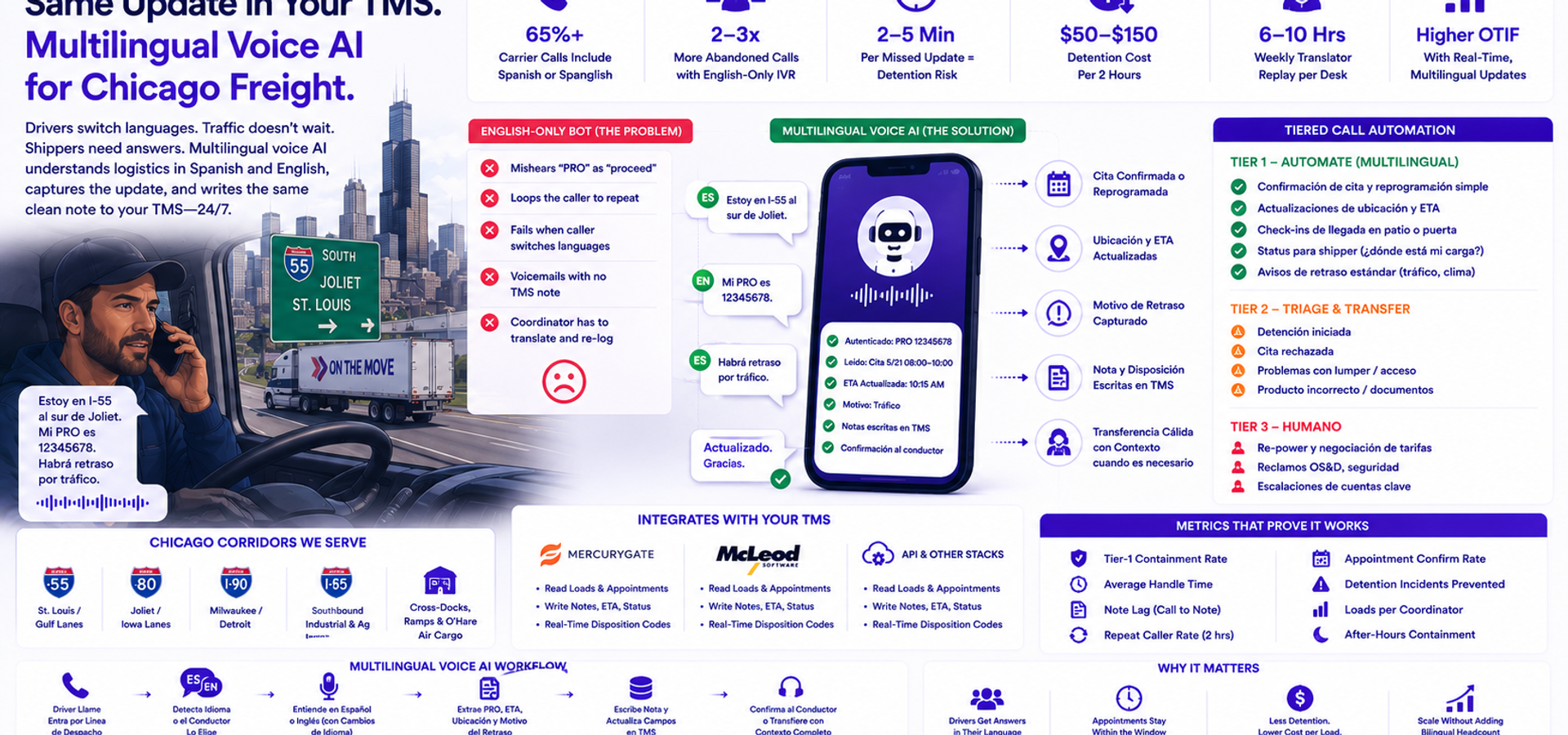
A driver calls from I-55 south of Joliet. They start in Spanish, switch to English for the PRO number, then back to Spanish for the delay reason. Your English-only IVR loops. Your coordinator is on another line with a shipper. The appointment window slips, and detention starts ticking at a Will County receiver. Chicago regional freight corridors move too fast for monolingual phone trees. They need multilingual voice AI that understands logistics vocabulary in more than one language and writes the same clean note to your TMS either way.
This guide explains why Chicagoland lanes demand multilingual dispatch automation, which corridors and calls to pilot first, how voice AI connects to MercuryGate and McLeod stacks common in the market, and how 3PLs and brokers measure containment without hiring proportional bilingual headcount.
Why Chicago corridors are a multilingual dispatch problem
Greater Chicago is a national freight hub, intermodal ramps, cross-docks, O'Hare air cargo adjacency, and heavy truck volume on:
- I-55: southwest to St. Louis and Gulf lanes
- I-80: east-west through Joliet and into Iowa
- I-94 / I-90: Milwaukee, Detroit, and northern corridors
- I-57 / I-65: southbound agricultural and industrial feed
Operations desks serve shippers nationwide but answer calls from a workforce that often prefers Spanish on the cab speaker, plus Polish, Ukrainian, and other languages in warehouse and local cartage pockets. English-only automation fails not from lack of politeness, from misheard ETAs, abandoned calls, and coordinators manually translating the same update forty times a week.
Regional TMS context: MercuryGate TMS API for Chicago 3PL voice agents and McLeod PowerBroker check-call logging in Chicago.
What multilingual voice AI does on dispatch lines
Multilingual voice AI for freight is not generic translation, it is logistics conversation in the caller's language with TMS discipline behind it:
- detect language or accept caller choice early in the call
- handle English–Spanish code-switching on PRO, city, and appointment terms
- read appointment and status from TMS in plain language
- capture location, ETA, and delay reason with confirm-back loops
- post structured English disposition notes for shipper portals and coordinators
- warm transfer to humans with transcript when tier two triggers
Audio quality still matters on highway calls, pair multilingual ASR with acoustic noise-canceling phone bots for dispatch lines and low-latency voice AI for driver appointment scheduling.
English-only bot vs multilingual corridor voice AI
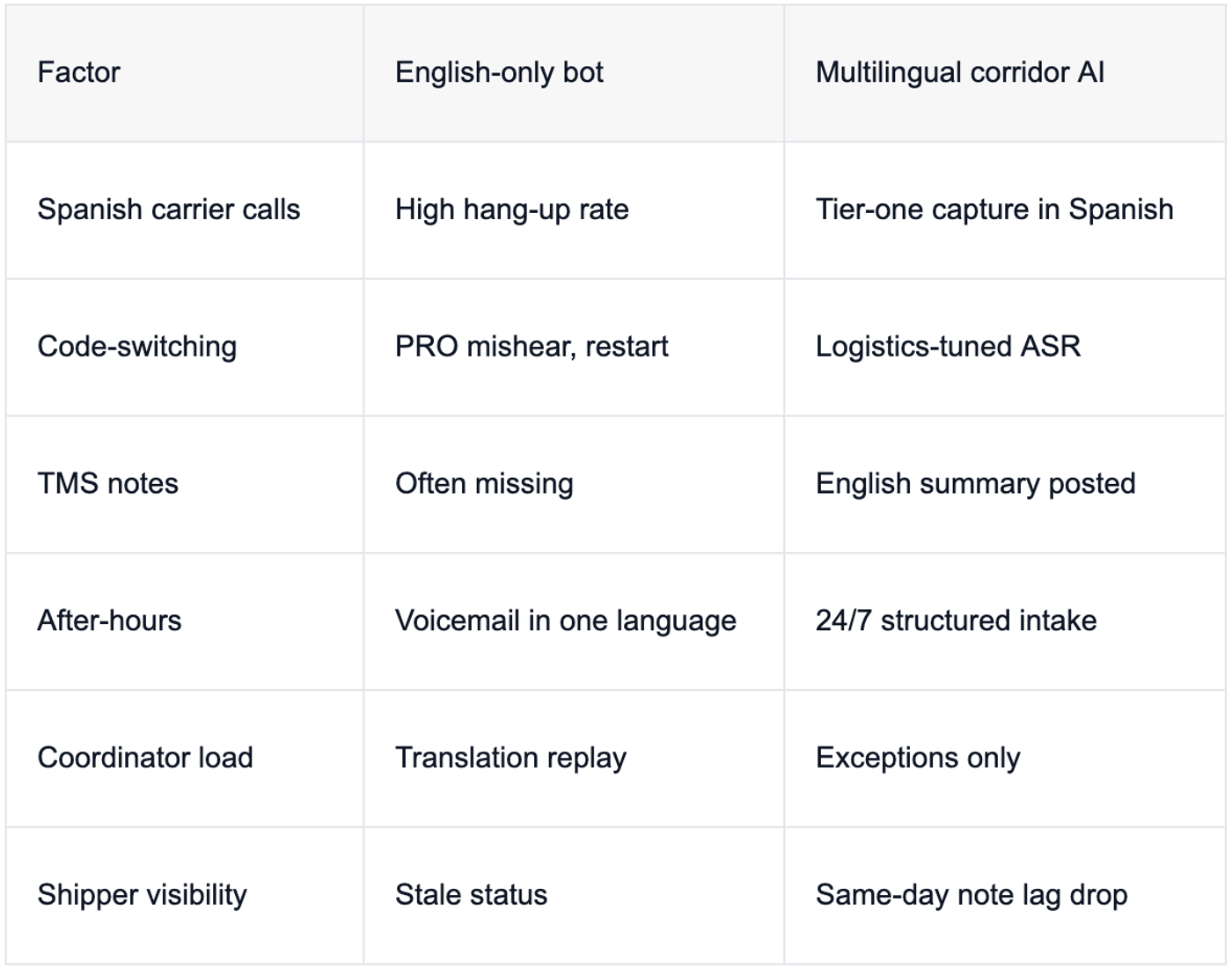
Inbound queue automation: automate inbound carrier tracking queues. Status write-back: automated load status updates in TMS.
Chicago corridor use cases to automate first
Tier 1: multilingual automate:
- appointment confirm at Chicagoland receivers and cross-docks
- inbound location and ETA on I-55 / I-80 lanes
- outbound check-call logging before warehouse windows
- shipper status readouts on high-volume accounts
- standard weather or traffic delay intake
Tier 2: triage + transfer: detention, refused appointment, lumper issues.
Tier 3: human: re-power, rate disputes, OS&D claims, strategic shipper escalations.
3PL cost frame: reducing 3PL operational cost per load. Brokerage scale: scaling load volume without tracking headcount.
Architecture: multilingual voice + Chicago TMS stacks
- Telephony: dedicated dispatch DID; after-hours line.
- Multilingual voice AI: English–Spanish pilot; language detect + confirm.
- TMS adapter: MercuryGate, McLeod, or API-equivalent read/write.
- Note policy: English disposition for shipper systems; retain audio for QA.
- Warm transfer: bilingual coordinator queue on tier-two keywords.
Stack planning: build vs buy voice AI stack, conversational services use cases, and technology used in supply chain management. Ops gap: the logistics decision gap.
Which languages to pilot (data beats assumptions)
Most Chicagoland freight desks start with English and Spanish, highest carrier-call share on regional van and reefer lanes. Add a third language when call sampling shows repeat volume that justifies script and QA cost (Polish warehouse calls, for example).
Run two weeks of labeled call review before build: language mix, top intents, mishear patterns on corridor names (Joliet, Gary, Rochelle intermodal). Tune vocab for Midwest place names and receiver aliases shippers use internally.
Broader AI map: AI in logistics use cases and AI supply chain technology trends.
Four-week pilot: one corridor or shipper lane
Week 1: Baseline
On I-55 or your busiest Chicago outbound lane, count inbound language mix, hold time, repeat callers, note lag to TMS.
Week 2: Read-only multilingual voice AI
English and Spanish status readouts from TMS; confirm-back on PRO; human approves write-back.
Week 3: Capture + outbound check
Enable location intake and scheduled outbound check calls in both languages; warm transfer on detention.
Week 4: Compare and expand
Measure containment by language, repeat caller rate, appointment-hit proxy. Add after-hours if metrics hold.
Dispatcher workload: how logistics teams cut dispatcher call load and AI voice agents for thousands of routine calls monthly. Peak: peak season without hiring dispatchers.
Metrics for multilingual Chicago corridor pilots
- containment rate by language (English vs Spanish)
- repeat caller rate within two hours
- PRO/load capture accuracy on sampled calls
- time from call end to English TMS note posted
- inbound answer rate on automated line
- coordinator minutes per load on pilot lane
- missed-call count vs baseline
Missed-call cost: hidden cost of missed calls in logistics. Shipper overflow: where is my shipment calls.
What multilingual voice AI does not replace
- bilingual coordinators for tier-two negotiation and key accounts
- shipper relationship calls requiring account history
- legal or claims conversations
- TMS data cleanup, bad load masters break every language
Where Dialflo fits
Dialflo deploys multilingual voice AI for Chicago regional freight corridors, English–Spanish logistics scripts, TMS-aware lookup, structured write-back, noise-robust ASR, and warm transfer when the corridor throws an exception detention cannot wait on.
Pilot one lane or shipper book on dialflo.ai when Spanish carrier calls still die in English IVR and your MercuryGate or McLeod notes still lag the cab by an hour.
FAQ: Multilingual voice AI for Chicago freight
Why Chicago specifically?
High corridor density, intermodal volume, and multilingual carrier workforce, monolingual automation leaves containment on the table.
English and Spanish enough to start?
Usually yes for pilot; expand from call-sample data.
Are TMS notes in English?
Typically yes for shipper portals; store audio for QA in caller language.
MercuryGate and McLeod supported?
Via API adapters, pilot read-only first; see linked Chicago integration guides.
What containment is realistic?
Set a tier-one containment target for each focused lane before you start, and validate it per language.
How does Dialflo help?
Multilingual voice AI for Chicagoland freight, see dialflo.ai.
Closing: corridors do not speak one language, dispatch should not pretend they do
Multilingual voice AI for Chicago regional freight corridors means every carrier hears tier-one answers in their language, and every shipper sees the same TMS truth in English afterward.
Sample your language mix. Pilot one corridor. Measure containment by language. Ready to test Chicagoland dispatch automation? Explore Dialflo for voice AI built for Midwest freight volume.