Replacing Legacy Freight IVR with Conversational AI

Dialflo: AI Voice Agent
June 16, 2026
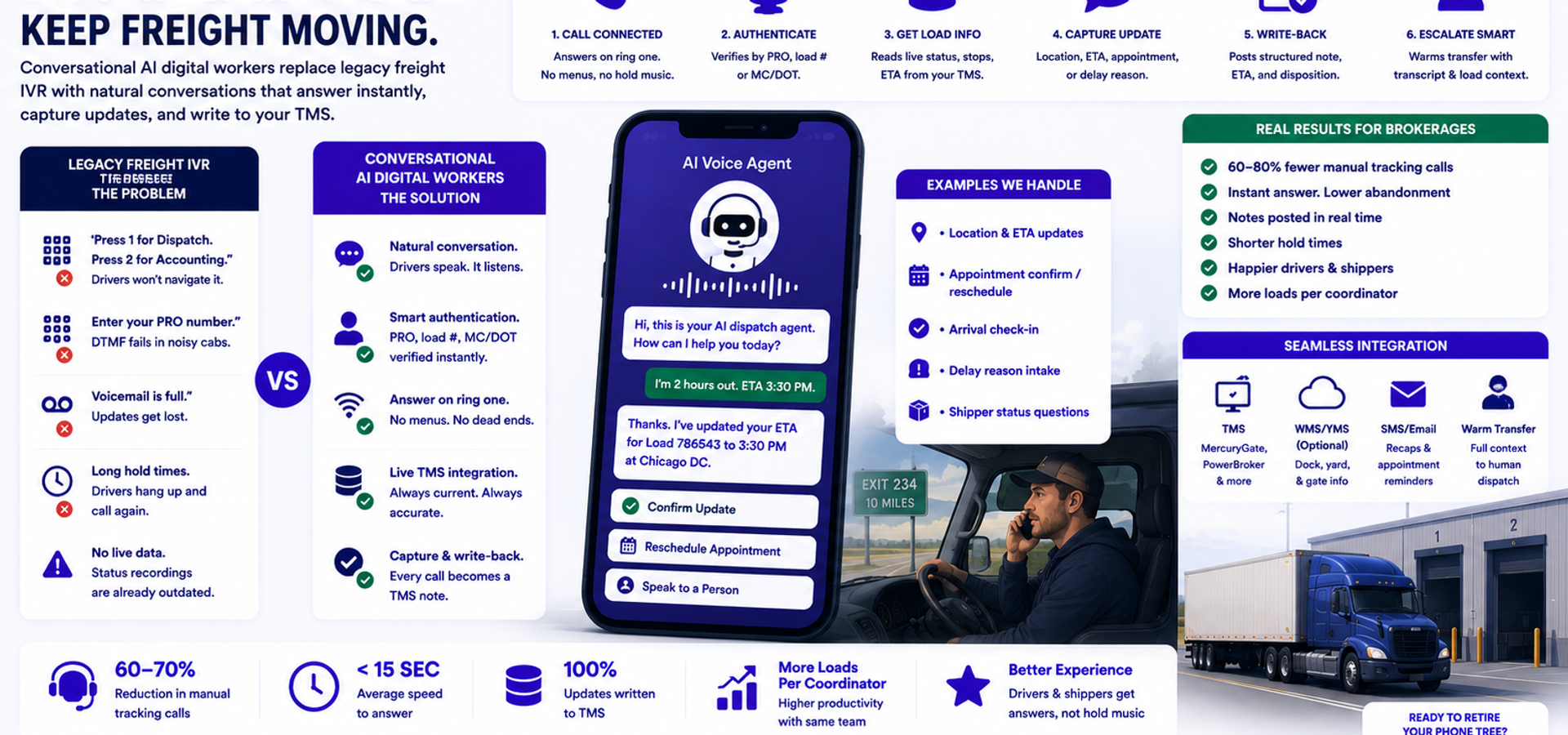
“Press 1 for dispatch. Press 2 for accounting.” The driver presses 1, enters a PRO digit-by-digit, hears “invalid entry,” and hangs up from a noisy cab. Your legacy freight IVR was built for office phones, not for carriers who call once, need a human answer, and will not navigate a six-level tree. Replacing legacy freight IVR with conversational AI digital workers is how brokers and 3PLs turn that hang-up into a captured ETA, a TMS note, and a tier-one containment metric instead of a callback war.
This guide explains why freight IVR fails, what conversational digital workers do differently, how to migrate without a big-bang cutover, and how to pilot on one lane before you retire the phone tree entirely.
Why legacy freight IVR breaks on dispatch lines
Most freight IVR systems were designed years ago for:
- fixed menu paths (“press 1, press 2”)
- DTMF digit entry for account numbers
- voicemail fallback when queues overflow
- zero TMS integration, status is a recorded message, not live data
Modern dispatch reality conflicts with all of that:
- drivers use speakerphone and Bluetooth, DTMF fails constantly
- callers want natural speech: “I’m at the receiver, running two hours late”
- inbound spikes at 7 a.m. exceed coordinator capacity
- shippers expect portal-grade status on a phone call
- every minute of hold music increases repeat calls and missed updates
Phone-tree context: logistics operators replacing phone trees with conversational voice AI. Missed-call cost: hidden cost of missed calls in logistics.
What conversational AI digital workers are (in freight terms)
Conversational AI digital workers are voice agents that work like tier-one coordinators, they:
- answer on ring one with natural language, not a menu
- authenticate by PRO, load number, MC/DOT, or shipper reference
- read live status from your TMS
- capture location, ETA, appointment confirm, or delay reason in one turn
- post structured disposition notes after hang-up
- warm transfer to humans with transcript on exceptions
They are not chatbots on a website. They are phone-native digital workers on your dispatch DID, 24/7 if you choose, built for cab noise and short caller patience. Audio stack: acoustic noise-canceling phone bots for dispatch lines and low-latency voice AI for driver appointment scheduling.
Legacy freight IVR vs conversational digital workers
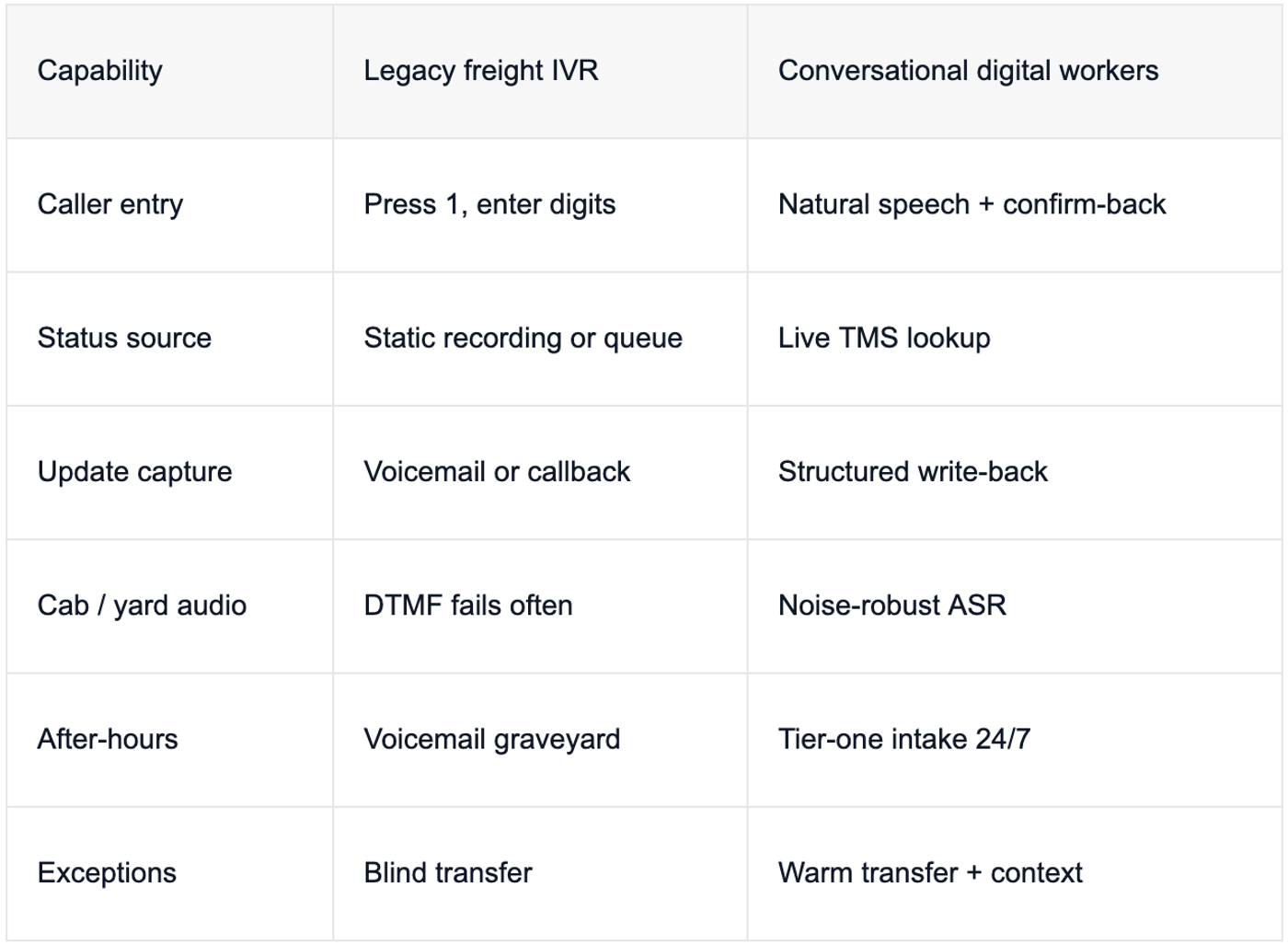
Conversational services primer: conversational services use cases. AI logistics map: AI in logistics use cases.
Which calls to move off IVR first
Tier 1: route to digital workers (retire IVR branch):
- inbound carrier location and ETA updates
- appointment confirm and simple reschedule intake
- inbound shipper “where is my freight?” status readouts
- outbound check-call logging scripts
- standard delay notice before detention escalates
Tier 2: digital worker triage + human: detention starting, refused load, OS&D intake.
Tier 3: human only (keep direct line): re-power, rate disputes, safety, key accounts.
Inbound automation: automate inbound carrier tracking queues. TMS write-back: automated load status updates in TMS.
Migration plan: IVR to digital workers without big-bang risk
- Audit IVR paths: count volume per menu branch; label tier-one vs exception.
- Baseline metrics: hold time, abandon rate, repeat callers, note lag.
- TMS read-only pilot: digital worker answers status; humans approve notes.
- Parallel run: keep IVR on backup DID; route primary line to digital workers.
- Retire branches: disable press-1 tracking when containment holds two weeks.
- Expand: outbound check, after-hours, multilingual if corridor needs it.
Chicago stacks: MercuryGate TMS API for Chicago 3PL and McLeod PowerBroker check-call logging. Multilingual corridors: multilingual voice AI for Chicago regional freight corridors.
Architecture: digital workers on the dispatch stack
- Telephony: port dispatch DID or add parallel number.
- Conversational voice AI: scripts, NLU, authentication, warm transfer.
- TMS adapter: read trip; write notes, ETA, disposition.
- Rules engine: outbound when appointment risk fires.
- Dashboard: containment, mishears, repeat callers by lane.
Build vs buy: build vs buy voice AI stack. Decision gap: the logistics decision gap. Supply chain tech: technology used in supply chain management.
Four-week pilot: one IVR branch at a time
Week 1: Map and measure
Export IVR logs, top three branches by volume; sample ten abandoned calls; document why callers failed the tree.
Week 2: Read-only digital worker
Replace “press 1 for tracking” with conversational status readout from TMS; human approves write-back.
Week 3: Inbound capture + outbound check
Enable location intake and scheduled outbound; warm transfer on detention keywords.
Week 4: Retire one IVR branch
Compare abandon rate, repeat callers, note lag. Disable menu path if metrics beat IVR baseline.
Scale playbooks: scaling freight brokerage load volume without tracking headcount, reducing 3PL operational cost per load, and how logistics teams cut dispatcher call load.
Metrics: prove IVR replacement worked
- IVR abandon rate vs digital worker completion rate
- tier-one containment (no human transfer)
- repeat caller rate within two hours
- time from call end to TMS note posted
- average hold time (target: zero on automated line)
- coordinator minutes per load
- missed-call count on dispatch DID
Volume pillar: AI voice agents for thousands of routine calls monthly. Peak: peak season without hiring dispatchers. Trends: AI supply chain technology trends.
Common mistakes when replacing freight IVR
- swapping menu trees for a slow generic bot, containment drops further
- no TMS integration, callers still get stale recordings
- big-bang cutover before read-only week proves accuracy
- no warm transfer, drivers hate “I can’t help” dead ends
- ignoring cab noise, pair with noise-robust ASR from day one
Shipper overflow: where is my shipment calls. Exceptions: reducing delivery exception calls before ops.
Where Dialflo fits
Dialflo helps teams succeed at replacing legacy freight IVR with conversational AI digital workers, TMS-aware voice agents, low-latency natural language, structured write-back, outbound check calls, and warm transfer when the load needs a human.
Pilot one IVR branch on dialflo.ai when abandon rate climbs every Monday and coordinators still replay the same tracking call instead of moving freight.
FAQ: Freight IVR to digital workers
What is wrong with legacy freight IVR?
Menus and DTMF fail for cab callers; status is rarely live; voicemail creates note lag and repeat calls.
What are conversational AI digital workers?
Voice agents that handle tier-one dispatch calls with TMS lookup and write-back, like always-on coordinators.
Can we run IVR and digital workers in parallel?
Yes, recommended during pilot; retire branches when containment beats baseline.
How long to pilot?
Often 2–4 weeks on one high-volume IVR path.
What containment is realistic?
Set a tier-one containment target for the pilot before you start, and validate it on your own lanes.
How does Dialflo help?
Conversational digital workers for freight dispatch, see dialflo.ai.
Closing: retire the maze, keep the coordinator
Replacing legacy freight IVR with conversational AI digital workers is not about removing people, it is about removing press-1 friction so coordinators handle detention, not thirty identical PRO readouts.
Map your top IVR branch. Pilot read-only week one. Measure abandon rate and note lag. Ready to retire the tree? Explore Dialflo for voice AI built for freight dispatch.